Category: Carl Jung

  • Trickster creates

    Trickster creates

    Feeling distressed, we might engage with a creative medium within a contained transitional space and be surprised to discover the reality of the living psyche, of unfamiliar content in the new creation, a message ‘from the deep.’

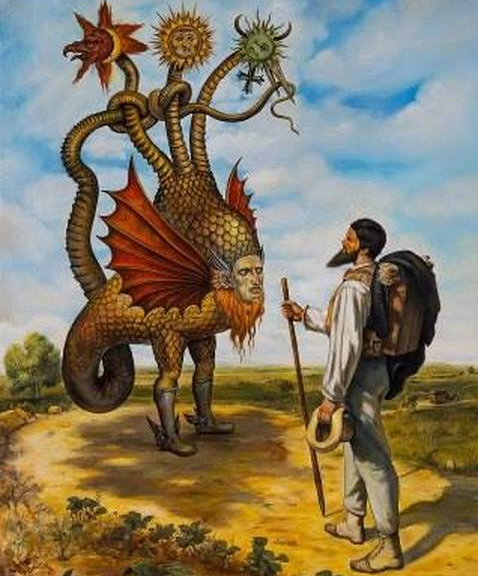
    “Trickster makes this world,” he creates playfully. (Lewis Hyde, 1998) He sits on the ‘border;’ he ‘opens or closes’ the connecting door between our inner and outer worlds. He re-members or dis-members, symbolizes or dissociates us. (Kalsched, 1997, p. 197)

    A playful approach to life’s difficulties allows one to play around with possibilities in difficult times, to adapt. A traumatized child has difficulty in relaxing and playing.

    Trickster makes this world, he makes links, he creates. He is the driving force in what Jung described as the Transcendent Function. This function aims at restoring inner imbalance. Therefore, if there is an emotional need and if we create the right circumstances, the trickster will come, because he wants to come.

    The conscious personality is goal-directed and has to adapt to the outer world; this is what it has to do. But this is often not beneficial to the whole or complete personality. Because it is mostly unconscious, it is not possible for the conscious personality to keep its own wholeness in mind. This imbalance then activates the trickster who tries to restore the balance, e.g. through a slip of the tongue, a dream image, or in symbolical creative work. The imbalance can also be mediated in the transference between analyst and analysand. (CW8:134-8)

    The creative play of the transitional space produces symbolical content. A symbol is an image of psychic energy, a complex fact, not fully understood by consciousness; it portrays “an objective visible meaning, behind which an invisible profounder meaning is hidden.” (Jacoby, 1957, p. 77) It brings together conscious and unconscious content. From a conscious point of view, it often appears as a paradox.

    When relating to it, inviting it into one’s real lived life, it nourishes immature wounded aspects of the personality, in turn supporting the process of individuation, of growing towards greater maturity.

    In symbolical creative work one may find a window on the unfolding, lifelong process of becoming.

  • Synchronicity

    Synchronicity

    Synchronicity refers to two or more events that appear simultaneously, that were born from the same moment in time. It means that they are meaningfully related, although they do not originate from the same cause. (1)  

    I Ching, the ancient Chinese book of wisdom, is based on an acausal system as opposed to the familiar Western system of cause and effect, and centers around the concept of what Jung had named synchronicity or meaningful coincidence.

    Jung described it as “the simultaneous occurrence of a certain psychic state with one or more external events which appear as meaningful parallels to the momentary subjective state and, in certain cases, vice versa.” (2)

    At Richard Wilhelm’s memorial service in 1930 Jung expressed his gratitude for Wilhelm’s translation of I Ching described it as radiating the simplicity and ‘plantlike’ wisdom of Chinese culture. It emerged, came into being, as if like a light out of thousands of years of dark background ‘horrors.’ (3)

    In Western culture it answers a need, with Christianity having become ‘debilitated.’ It no longer contains us with wisdom. Western culture is tired of rationalism and intellectualism; it “wants to hear truths that broaden rather than restrict, that do not obscure, but enlighten, that do not run off them like water, but penetrate them to the marrow.” But new sensations alone will not help us; we have to “earn the right to it by working on ourselves.” (4)

    Jung wrote a foreword to Wilhelm’s translation of I Ching. He viewed it as a testimony to his individual experience of the book: he asked the oracle for its judgement on Jung’s intention of presenting it to the Western mind. In answer I Ching told him “of its religious significance, of the fact that at present it is unknown or misjudged, of its hope of being restored to a place of honor.” (5)

    I Ching, whose wisdom may be said to center around the principle of Tao, refers to a quest for meaning in life. This has become a collective phenomenon in our time (6).

    Seen from this perspective, I Ching can be a great support to anyone seeking deeper meaningful containment.

    Image credit: Bodhi Tree Leaf Yin Yang artwork from the Royal Thai Art website.

    References:

    1. CG Jung, CW 8 par 849.

    2. CG Jung, CW 8 par 850.

    3, 4, 6. CG Jung, CW 8. Richard Wilhelm: In Memoriam, par 87 – 90.

    5. Foreword by CG Jung from I Ching, The Wilhelm Edition, p. xxviii.

  • The Wounded Healer

    The Wounded Healer

    The birth of healing power from the ‘original wound’ that we must address in the therapeutic relationship, belongs to the archetype of the wounded healer. Jung described this archetype as “the mythological truth that the wounded wounder is the agent of healing, and the sufferer that takes away suffering.” (1)

    The myth refers psychologically to the capacity “to be at home in the darkness of suffering and there to find germs of light and recovery with which, as though by enchantment, to bring forth Asclepios, the sun-like healer” (2)   

    Chiron, then, represents ‘the one who is wounded,’ the one who wounds self and others, ‘the wounder’, and ‘the one who suffers’ because of the wounding. (3) Asclepios, often called the Father of Medicine, was said to have been rescued from his mother’s funeral pyre and raised by the centaur Chiron, who taught him the art of healing. (4)

    An archetypal image can manifest in human psychology consciously or unconsciously, but mostly as a mixture of the two, entangled with our wound and presenting us with a problematic situation which we must address consciously, both as therapist and as patient.

    The therapist as the healer has his/her own wound which may be drawn in if it provides ‘hooks’ for the patient’s projections. By each working separately on the problem, the archetype is constellated within the therapeutic space, bringing movement along the path. (5)

    The wound holds a key: it plays an important role in the process of individuation as that which is the source of one’s inner suffering as well as the bringer of healing and transformation, not only to oneself, but also to others, a gift in service of Life. Looking back upon wounding encounters, we might see that it brought us inner growth and a deepening of compassion.

    Von Franz said that, “In seeking for the meaning of your suffering, you seek for the meaning of your life. You are seeking for the greater pattern of your own life, which indicate why the wounded healer is the archetype of the Self – one of its most widespread features – and at the bottom of all healing procedures.” (6)

    It might therefore be helpful to ask yourself: what purpose does my suffering, my difficulty serve?

    References:

    1. CG Jung, Four Archetypes p. 136
    2. ARAS Concordance (wounded healer/TRANSFERENCE-COUNTERTRANSFERENCE): E. Edinger, Mysterium Lectures p. 317
    3. M Reinhart, Chiron and the Healing Journey p. 81.
    4. ARAS Concordance (wounded healer/NIGREDO): E. Edinger, quoting Kerenyi, Anatomy of the Psyche par 0.
    5. ARAS Concordance (wounded healer/SHRINES-AND-ORACLES-OF ANCIENT-GREECE): E. Edinger, Eternal Drama par 0.
    6. ML von Franz, Puer Aeturnus p. 114
  • Aion

    Aion

    Only once did Jung name a book after a god; this god was Aion. Aion-Khronos represents a father-god, Greco-Roman with Persian influences. His cult, Mithraism, (100 – 500 AD) was destroyed by Christianity. (1) Jung said about Aion:

    “In the cult of Mithras there is the key god Aion. He is represented with the winged body of a man and the head of a lion, encoiled by a snake which rises up over his head. He is Infinite Time and Long Duration, the supreme god of the Mithraic hierarchy, and creates and destroys all things, a sun-god. As the lion-headed god with the snake around his body, he represents the union of opposites, light and darkness, male and female, creation and destruction. He is represented as having his arms crossed and holding a key in each hand. He is the spiritual father of St. Peter, for he too holds the keys. The keys which Aion is holding are the keys to the past and future. The idea of the key is often associated with the mysteries in the cave.” (2)

    In the Mithraic mysteries the serpent and the lion are opposites; to be entwined is to be devoured, to return to the mother’s womb. As a symbol of time, Aion has the zodiac portrayed on his body. Time is expressed through the dawning and extinction of consciousness, death and rebirth, to come into being through ‘infinitely long duration,’ through repetitive transformations of the creative force, libido. (3)

    As in the ancient moon mysteries, where Dionysus was sacrificed as the bull-god and son-lover of the Great Mother, symbolizing the sacrifice of animal nature, so in the Mithraic mysteries (4) Mithras overcame his immortal brother symbolized as the bull, by killing, eating and integrating him ceremonially. (1)

    Jung described Mithraism as a complete solar psychology, aimed at restoring the relationship between the mortal and immortal brothers: Mithras as consciousness and the bull as the archetype, the Self. He added that the relationship in which they stand to each other is similar to the relationship between St. Peter and Christ. (5)

    Aion has two keys, the keys to the past and to the future. The pattern of death and rebirth, of descend and return, is the ancient shamanic journey. We are familiar with the descent of Inanna, of Persephone, of Osiris, to name but a few. This pattern is a fundamental pattern of change and growth stretching back into the past. It is the descent and return of Christ. But it is also the key to the future. In psychology, in Jung’s work, we find a new form of the old night-sea journey.

    The slow unfolding of this archetypal process, the cruel immaturity of the god, the cultural manifestation of the process, have to be suffered through by humanity over time. This is how we as humans may contribute to the manifestation, the creation, of our world.

    The chaotic times which we live in may also be seen against this background.

    References:

    1. Ancient History Encyclopedia / Mithraic Mysteries website.

    2. CW 18 par 266

    3. CW 5 par 425

    4. CW 5 par 659

    5. CW 5 par 288