Category: Symbol

  • Symbolism of the Stone

    Symbolism of the Stone

    In modern culture, diamonds are often associated with making a commitment in a long-term relationship, felt to signify the rock on which it is built. A precious stone is a symbol of the lapis lazuli, the Self.

    The aim of the process of individuation is to restore the relationship to the Self, an inner mystery. A positive outcome of the process may culminate in the integration of the inner opposites, symbolized as the masculine and feminine principles, in the sacred inner marriage.

    ‘Petra’ means rock, and Peter was said to be the rock on which the church was built. We associate the stone with permanence: something may be ‘written in stone’. Stones have also been used to shape religious objects and temples since ancient times. Stonehenge continues to leave us in awe. Meteorites were found in some ancient temples and were revered as the deity itself.

    As a child, Jung loved to sit on a large stone. He used to think that he was also the stone. Then again he was the boy. He would get off the stone, feeling confused. Was he Carl, the boy, or was he the stone, old and wise? This was the beginning of what he called his number one and number two personalities, leading to his later understanding of the ego and the Self.

    Later in life Jung ‘rescued’ a rock which had been rejected by the mason. It was a perfect cube, too large for its purpose, and he let this stone speak for itself. The first thing that he chiseled into the stone, was a Latin verse:

    “Here stands the mean uncomely stone,
    ‘Tis very cheap in price!
    The more it is despised by fools,
    The more loved by the wise.”
    MDR, p. 227

    In alchemy, it was said that the cornerstone, the lapis, was rejected by the masons and was called the orphan. In therapy we often discover essential aspects of our personalities that were rejected early in life and which we rejected turn out to be the cornerstone of the individuation process and the core of the personality.

    Photo credit: Marcelo Jordao, Yarden Life Center in Brazil.

  • Symbolism of Water

    Symbolism of Water

    We associate our emotional life with water. Without our world of emotions, we are stranded in a dry blazing desert, the world of one-sided mind. Logical thinking has its place but is often over emphasized in modern culture.

    Water flows together: our emotional life unites things. When cleansed, it is nourishing. Without water, no life is possible.

    Water is able to flow around an obstruction and flow on. It fills up the empty space and takes on its shape: it adapts.

    Water reflects light. When we are able to relate to our emotional life, we are better able to reflect upon ourselves and our lives. Mourning forms a central aspect of the process of self-acceptance. Grief allows the old life to become compost for the new.

    Water is the solvent: old structures, depleted of their content, may be dissolved in water. After a period of drought, rain brings a feeling of release, of relief of tension.

    Creation myths often tell us that water was the source from which everything originated. When a pregnant woman’s water breaks, birth is imminent. ‘The waters’ have been associated with the Great Mother symbolism since ancient times: the place of the waters is the Great Mother, and the place from which we might be reborn, renewed.

    Creation myths tell us about upper and lower waters. The waterfall connects the waters of above with the waters of below, it connects the higher values with the everyday world. The tree and the fountain likewise connect upper and lower; it draws up the water from below, the water of the earth, the well-springs of life, wisdom, and make it available to anyone who delve down deep enough within her/himself.

    A more conscious integrated perspective on life brings the possibility of compassion that is objectively contained, water with shape, also sometimes called Eros.

    Image credit: Lea van Rensburg

  • Symbolism of the Well

    Symbolism of the Well

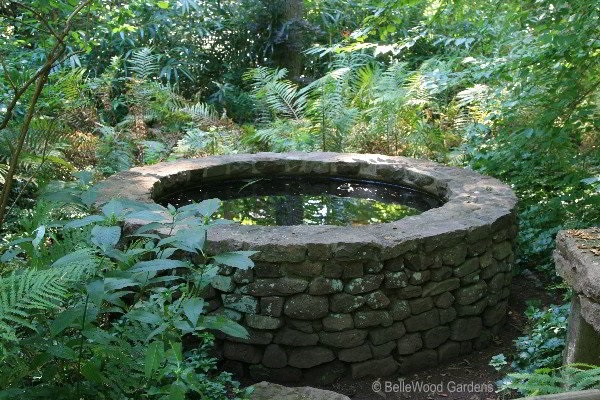
    Wells have been associated with sacred ceremonial descent, ritually lived, for millennia. Like the holes in the ground, hand-dug by men and women over time, it resembles the development of consciousness over time. Over time, archetypal patterns of descent, linking above and below, ego and Self, became more fully known by humanity and potentially available to anyone who would ‘go down all the way’ to the roots, who ‘does not neglect the work.’ (1)

    All over the world, wells have been dug by hand at least since the ninth millennium BCE. (2) Human settlements have always been dependent for survival on a well with a fresh clear spring, so that social structures developed around it. We depend upon it.

    The symbolism of the well and the tree have something in common. The water of the well can be drawn up from the deep to serve life and growth in the community. In the same way, a tree draws up water through its roots and fibers from the deep in order to grow.

    The well conveys the idea that the nourishing wellsprings of life is available to all, no matter how desperate you are feeling. It is inexhaustible. It grows neither less nor more; it exists for one and all. Generations come and go, and all may enjoy life in its inexhaustible abundance. (2)

    A well needs to be maintained, cleaned, lined and so, also, the relationship to one’s deeper self. Through Jung’s psychology, the existence and mechanisms of this psychic structure was made conscious and accessible to any individual who felt called upon to undertake the work of descent. Then the inner relationship with one’s roots may be restored and the individual may find meaningful nourishment.

    Our modern world is dominated by rationality and superficiality resulting in loneliness and meaninglessness, but by restoring the relationship with one’s deeper personality one may draw from the wellsprings of Life to find meaningful containment and inner guidance from your own roots.

    1. I Ching, p. 185 – 6

    2. Wikipedia.org, well

  • Symbolism of the Tree

    Symbolism of the Tree

    The tree represents the manifestation of the life-force, of our ability to grow into greater maturity; when faced with an impossible life situation, one should not try to force anything, but ‘stay in one place and grow, like a tree.’ (Jung, Dream Seminars, 1929)

    Growing is a slow process. Only swamp plants shoot up overnight. Inner growth may enable one to outgrow and rise above a difficult life situation, to attain a more objective perspective and discover alternative options that may have been there all along. A very large tree may grow from a very small seed.

    The seed has to break open and grow towards the light, the higher values. Breaking open is painful, but necessary; without it there will be no growth. The tree roots us. Its roots stretch away into the darkness of the earth, into the shadow. Like the fountain, the tree may draw water from deep beneath the earth, from the well-springs of life, if the roots reach deep enough.

    A tree goes through seasons of spring, summer, autumn and winter. After the death-like feeling of winter, stripping away the old, new life returns, blossoming, ripening our fruit. Animals and birds may be fed and sheltered. When the time comes again, we shed our beautiful autumn colors so that it may become compost for new life. Our lives circle continuously through periods of spring, summer, autumn, winter and spring again.